


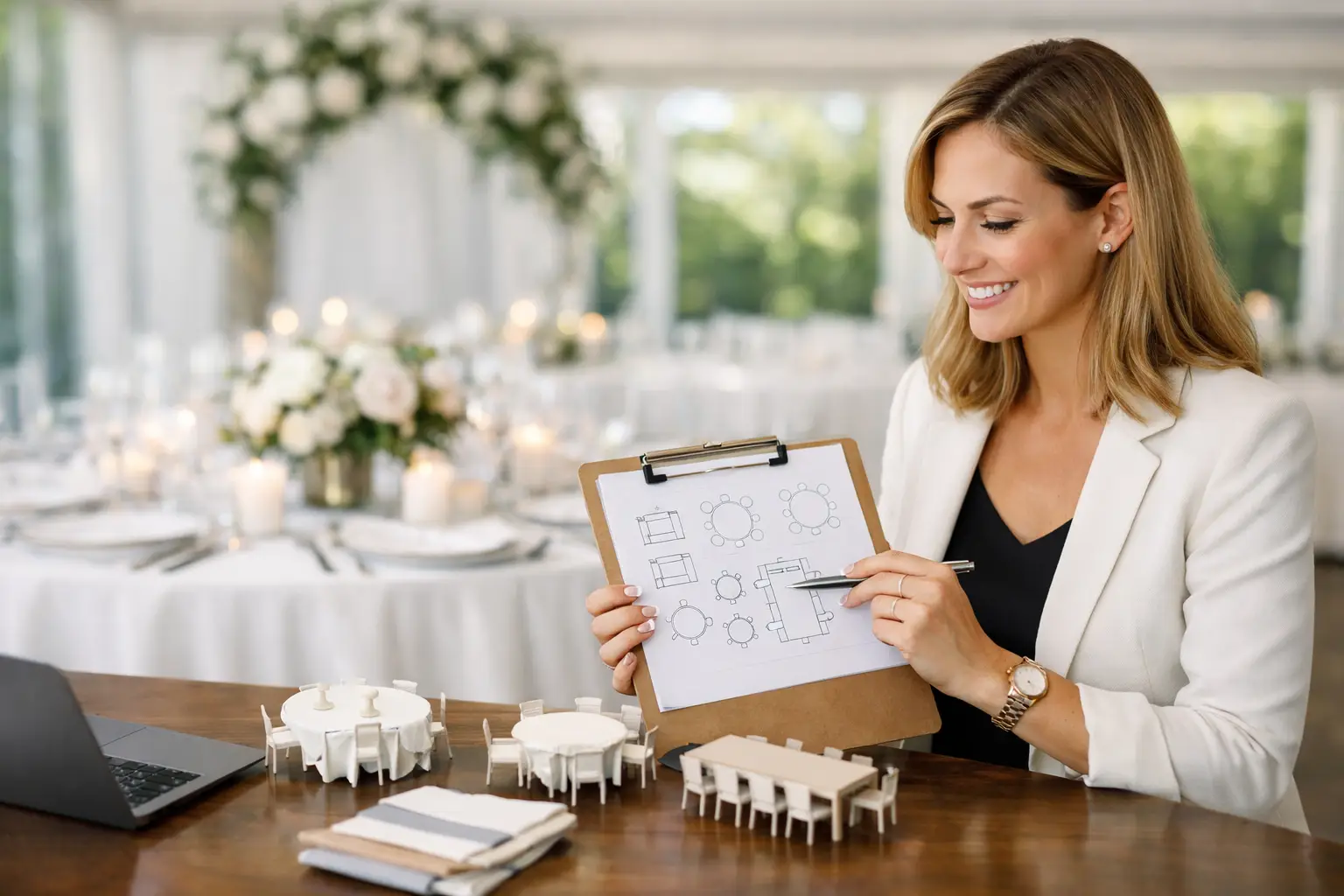
Table layout for the wedding banquet
The distribution of wedding banquet tables is not solved solely by placing names on a plan. It is the time when families who may not see each other much, friends from different stages and people from other countries share hours of conversation, toasts and emotions. Good organization makes everyone feel expected, comfortable, and part of your story.
At a wedding, the seating plan has a double mission: to take care of the experience of each guest and to allow the service to move forward naturally. That is why it is advisable to approach it with time, criteria and a very personal look. It is not a matter of fulfilling a formula, but of finding the distribution that accompanies the atmosphere you dream of for your day.
When to start wedding banquet table layout
The final plan cannot be closed until you have the final confirmations, but you can prepare the base well in advance. When building your guest list, write down relevant links: close family members, groups of friends, co-workers, people traveling together, mobility needs, or languages that can facilitate conversation.
About six to eight weeks before the wedding is usually a good time to design a first outline. This will give you room to adjust it when the last answers come in, without turning this decision into a last-minute race. Casualties happen and tables change: it’s not a sign of poor planning, but a regular part of the process.
Before assigning a single chair, confirm how many people can comfortably fit at each table and what shape the setup will be. A round table favors an open conversation among all its diners; the imperial tables create a very Mediterranean image and encourage lateral dialogue; rectangular ones allow for more flexible compositions in small groups or elongated spaces. Aesthetics matter, but comfort must come first.
Start at the presidential table
The presidential table sets the tone for the banquet. Traditionally it is reserved for the bride and groom, their parents and, sometimes, siblings or witnesses. However, there is no obligation to follow this model if it does not reflect your way of celebrating.
Many couples choose an intimate table for two, a table with their closest friends, or a composition shared with family. You can also sit at a table integrated between the guests, especially if you are looking for a relaxed and close celebration. The best option will be the one that allows you to enjoy without feeling that you are playing a role that does not belong to you.
Whatever your choice, value visibility. You want to be able to see the whole room, listen to the speeches and easily access the important moments. At the same time, avoid being isolated next to an area of constant passage, the stereo or a service door. The distribution should allow you to receive hugs and congratulations, but also to be able to savor dinner.
A bride and groom table alone or accompanied?
There is no universal answer. A table for two can give you a small refuge within an intense day and works especially well at destination weddings, where guests tend to mingle easily. An accompanying table, on the other hand, creates a warm and familiar feeling.
Think about your personality and the type of celebration. If you love being at the center of the conversation, you may appreciate sharing a table. If you prefer to have a few minutes of calm between so many moments, a bride and groom table can be perfect. The essential thing is that the decision represents you.
Group by affinity, not just kinship
The most useful criterion for distributing guests is simple: seat together those who can genuinely enjoy the conversation. Family is important, of course, but kinship does not always guarantee affinity. A cousin of your age who knows your friends may feel more comfortable with them than at a table of relatives with whom she hardly coincides.
Form natural nuclei first: friends from university, classmates from a hobby, family of the same generation, groups that have traveled together or couples who already know each other. Then check each table to see if there is a balance of ages, interests, and energies. It is not necessary for everyone to share the same profession or to have known each other for years. It is enough that they have a possible conversation and a friendly atmosphere.
At weddings with guests of different nationalities, it is advisable to take into account the language. Mixing cultures can be beautiful and memorable, but a table where a person doesn’t understand any conversation can become a lonely experience. You can combine international groups as long as there is a common language or someone who is especially open to helping build bridges.
It is also advisable to avoid having one person arrive alone at a table where everyone else has a very close relationship. If they don’t have a companion, find a cozy group and introduce them to someone with whom they share interests first. That small gesture is very noticeable during the celebration.
Think about the physical comfort of each guest
A beautiful layout should work in practice. Seniors will appreciate an easily accessible location, away from loudspeakers and areas with too much traffic. Families with infants or toddlers may need space to move around, proximity to an outing, or a table where other parents understand each other.
If there are guests with reduced mobility, contemplate the routes from their arrival: not only the chair, but the passage between tables, access to the bathroom and the ease of going out to the terrace or the dance area. These kinds of details are not seen in a photograph, but they determine how a person feels throughout the night.
The proximity to music also deserves attention. There are guests who enjoy the lively atmosphere and others who prefer to chat without raising their voices. You can place the most partying groups near the dance floor, leaving the quieter tables in a somewhat more protected area. It is not separating people by age, but respecting different ways of experiencing the party.
Avoid tables built by compromise
The table of “those who remain” is one of the most common mistakes. It usually appears at the end, when there are a small number of people left and you try to fit them in without thinking too much. The result can bring together guests without connection, with very different rhythms or even with previous tensions that do not need prominence at your banquet.
If a table is incomplete, nothing happens. A slightly smaller, well-thought-out table is often preferable to filling every spot at all costs. Another possibility is to calmly redistribute one or two groups, without breaking the main affinities. Maximum capacity is not always ideal capacity.
Nor do you sit people with known conflicts together just to avoid explanations. Your wedding should be a space of joy, not an occasion to resolve family disagreements. You can be discreet and kind without sacrificing anyone’s peace of mind.
The floor plan should be easy to understand
Once the distribution has been defined, it is time to communicate it. The seating plan should be read at a glance, especially after the cocktail party, when guests are eager to find their table and sit down. Choose a simple nomenclature: numbers, names of places that have meaning to you, flowers or corners of a shared trip. The key is that each table is identified without confusion.
Check several times the spelling of names, double surnames, treatments and allergies or special menus that those responsible for the service should know. If there are children, clearly indicate where they sit and who their reference adults are. A neat shot conveys attention, but above all avoids unnecessary questions and movements at the beginning of dinner.
At Bella Events Spain we understand this phase as one more piece of global coordination: a plan that dialogues with the decoration, respects the rhythm of the service and makes each guest feel welcome. When everything is planned, you can dedicate yourself to what is really important: looking at each other, toasting and celebrating.
Make room for final changes
Even if the plan is very well worked out, reserve a small dose of flexibility. A last-minute cancellation, a couple confirming late, or an unexpected need can force several cards to be moved. Save an updated version of the map and avoid printing it too early if relevant answers are still missing.
On the day of the wedding, a trusted person or your coordination team must have the final version. That way, if a doubt arises, you won’t have to leave your celebration to figure out where someone sits. Your only job will be to enjoy that moment in which, finally, all the people you love are together.
The best distribution is not the stiffest or the most perfect on paper. It is the one that allows a grandmother to talk calmly, for a friend who has traveled far away to find his place and for you to look up to see a room full of happy faces. That is the true design of an unforgettable banquet.

Outdoor wedding in summer: stress-free
Plan an outdoor wedding in summer with style and calm: schedules, shade, comfort, plan
How to plan a wedding in Ibiza without stress
Plan your wedding in Ibiza calmly: dates, budget, guests and details to enjoy a
How to choose wedding venues in Calpe
Find wedding venues Calpe and choose a Mediterranean space with views, privacy and an